The Mullaperiyar Dam exists because of a simple, brutal geographic accident. Heavy monsoon rain falls on one side of the Western Ghats and runs uselessly into the Arabian Sea, while the other side, the dry, famine-prone plains of the old Madras Presidency, gets almost none of it.
Why here?
The Periyar is Kerala's longest river, rising in the Western Ghats and flowing west toward the Arabian Sea. On the eastern side of the same mountains lies the Vaigai river basin, the Cumbum Valley and the plains around Madurai, sitting in the rain shadow of the Ghats and historically so dry the Vaigai itself often ran dry before reaching the city. Colonial-era writers summarized the imbalance bluntly: the Periyar's water was "of no use" to the sparsely populated Travancore hills, while it could transform the parched Vaigai basin.
The proximate trigger most sources cite is the Great Madras Famine of 1876–78, which killed over a million people in the Madras Presidency while Travancore, on the other side of the ridge, simultaneously experienced flooding. The engineering answer was to dam the west-flowing Periyar and cut a tunnel through the watershed itself, so water could be released east by gravity instead of running out to sea.
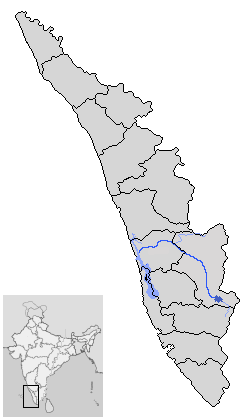
Travancore and the Raj
The Kingdom of Travancore was a princely state under British paramountcy, not part of directly administered British India. It kept its own Maharaja and Dewan (chief minister), but a British Resident could bring serious pressure to bear on the Travancore court. That asymmetry is the reason the Madras Presidency, a directly British-run territory whose drought-stricken districts stood to benefit, was able to negotiate a lease of Travancore's high-range land and water on terms that heavily favored Madras.
Before Pennycuick
The idea of sending Periyar water east predates the dam by a century. A Ramnad kingdom minister is credited with first exploring the idea in the late 1700s, sending a scouting party before the scheme was abandoned as too costly.
In 1808, Captain J.L. Caldwell of the Madras Engineers surveyed the route on the government's behalf. A primary-source government document rediscovered in this research quotes his actual verdict: the project would require a cutting over 100 feet deep through the watershed, which he judged "decidedly chimerical and unworthy of any further regard." He recommended nothing more than minimal level-taking. Caldwell, who later rose to Colonel and helped design St. Andrew's Church in Madras, effectively killed the idea for half a century.
A first physical attempt, an earthen embankment, was begun in 1850 and abandoned when laborers demanded higher wages over the malarial conditions. Real momentum returned with Captain (later Major) J.G. Ryves, who surveyed the site from 1862 and, in 1867, proposed a specific earthen dam design. Government records recovered for this project put its height at 162 feet, a figure that resolves a long-standing discrepancy in secondary sources, some of which cite 62 feet. An archival Madras PWD order from February 1862, also recovered for this research, records "the serious displeasure of Government on Captain Ryves." The substance of the reprimand isn't preserved, but it didn't stop his rise: he headed the Madras PWD's Superintending Engineer's Office by 1871. He is very likely the same Joseph Gore Ryves commemorated by the "Ryves Canal" on the Krishna river, though that connection isn't fully confirmed by an authoritative source.
Ryves's proposal was picked up in 1872 by an engineer named R. Smith, who submitted a complete design for a 171-foot earthen dam with a 7,000-foot tunnel. Two Madras PWD officers, Colonel Oakes and Colonel Mullins, approved it, but a Major-General Walker opposed actually building it, over concerns about the earthen construction method flooding out. The project stalled again.
Colonel Pennycuick
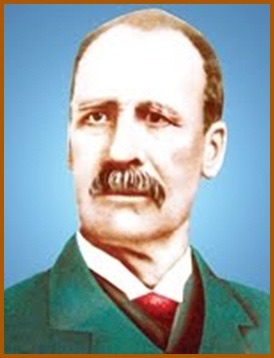
Colonel John Pennycuick, CSI (1841–1911) was the Madras Public Works Department engineer who finally built the dam. Born in Poona, the son of a Brigadier-General killed at the Battle of Chillianwala, he was educated at Cheltenham College and the East India Company's military college at Addiscombe before joining the Madras Engineer Group in 1858. He served in the 1868 Abyssinian Campaign with the Madras Sappers, earning the Abyssinian War Medal, and married Grace Chamier in 1879, the same Grace who, sixteen years later, would open the dam's sluice gates at its inauguration. He first examined the Periyar proposals briefly around 1870, then was placed in charge of producing a definitive plan in 1882.
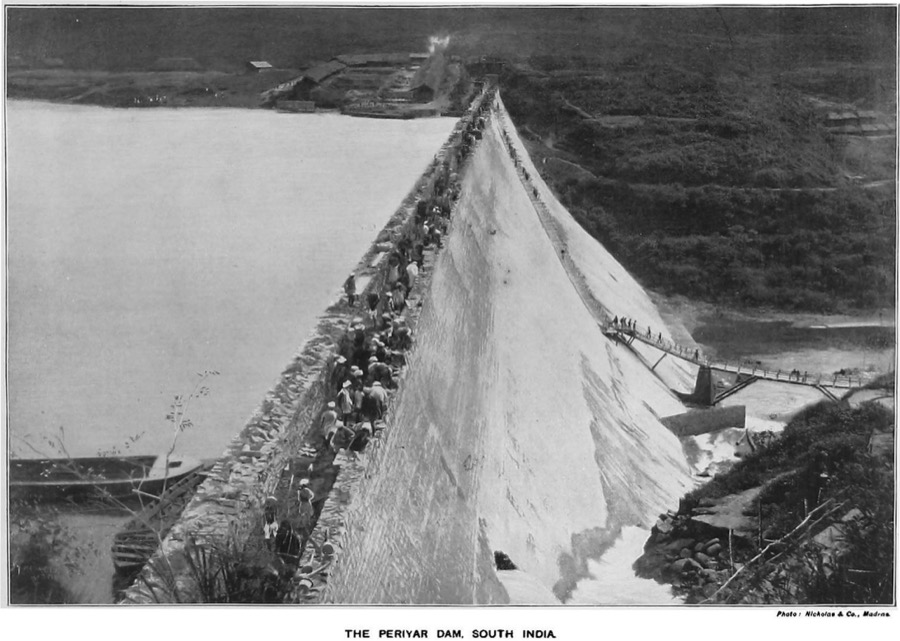
His proposal, approved in 1884, abandoned the earlier earthen-dam designs entirely in favor of a masonry gravity dam, roughly 155 feet high, paired with the watershed tunnel. It is essentially the dam that stands today.
He sold his family property in England to keep construction going after the government balked at repeated flood damage. Or so the story goes.
Widely repeated in Indian press and tourism material
The Pennycuick family's own history website, maintained by his descendants and the most careful non-Wikipedia source on him, states this "personal sacrifice" story is disputed by family members. The family's own historians do not confirm that he funded construction out of pocket. This is a real, unresolved conflict between popular legend (repeated in press coverage and embedded in Tamil Nadu's veneration of him, see Culture & Reserve) and the family's own skepticism.
Pennycuick was honored as a Companion of the Order of the Star of India on the day the dam was inaugurated, received the Telford Medal from the Institution of Civil Engineers, and later advised the Australian government on flood prevention for the Brisbane River. He retired to England in 1896 and died in Camberley in 1911.
The 1886 lease
On 29 October 1886, a lease indenture was signed between the Maharaja of Travancore and the Secretary of State for India. Sources have disagreed on which Maharaja actually signed it. This project traced the reign dates precisely: Visakham Thirunal, who spent much of his reign resisting the British proposal, died on 4 August 1885, fourteen months before the lease was finalized. His nephew and successor, Moolam Thirunal, was the ruler who actually signed it, a little over a year into his own reign, inheriting, in effect, a deal his predecessor had already been negotiated into.
The lease granted Madras the right to "all the waters" of the Periyar and its catchment, not a capped share, for irrigation. It also included a clause providing for its terms to be reviewed every 30 years, separate from the headline 999-year duration, a provision that, as far as this research found, nobody exercised for the lease's first 84 years, until the 1970 supplemental agreements. And the annual rent was, by some accounts, less generous than it sounds: it was offset against tribute Travancore already owed the British Crown as the paramount power, rather than paid as genuinely new revenue. That's a detail that bears directly on how favorable these terms actually were.
The Maharaja is widely quoted as saying, on signing, that he was doing so "with my blood." Despite searching contemporary records and a digitized 1886 government publication, no primary source for this quote has ever been located; it appears only in later press retrospectives with no cited original. Treat it as popular memory, not a documented utterance. It's one more reliably attached to Moolam Thirunal than to his predecessor, if it was said at all.
Building it, 1887–1895
Construction began in May 1887, using troops of the 1st and 4th battalions of the Madras Pioneers and Portuguese carpenters brought from Cochin to build the timber coffer-dams that kept the riverbed dry during work. Pennycuick himself described the workforce at peak as numbering "several thousand." The site was extraordinarily remote, seven miles from the nearest road and roughly eighty from the nearest railway, and malaria risk limited the working season to about nine months a year. Equipment on site included stone-crushing machinery, water turbines, pneumatic drills, and a roughly 3-mile wire ropeway for hauling material through the jungle: notably mechanized for a remote 1880s site. One source likens the Periyar's peak flow at the site to roughly half of Niagara Falls, which is why the temporary coffer-dams kept failing.
No cement was used. The dam's faces are rubble masonry set in lime-surkhi mortar, a mix of lime, surkhi (burnt brick powder), and sand, and the core, accounting for roughly 60% of the dam's total volume, is lime-surkhi concrete. This is the fact that sits at the heart of the modern safety debate: a 130-plus-year-old structure built with a water-soluble binder, not Portland cement.
Temporary coffer-dams were repeatedly destroyed by flash floods, most notably in March 1889, which triggered a funding crisis that is the real context for the Pennycuick "personal sacrifice" legend above. Foundation work, from December 1889 to April 1890, was in Pennycuick's own words "the most anxious, difficult and exhausting" phase of the project.
| Measure | Figure |
|---|---|
| Deaths (mostly malaria) | 483 (commonly cited; some sources say only "hundreds") |
| Height above foundation | 176 ft (53.6 m); 155 ft is sometimes cited, measuring from the riverbed instead |
| Length | 1,200 ft (also cited as 1,241 ft) |
| Cost | ~Rs 104 lakh (one source gives Rs 84.71 lakh for a narrower scope) |
The dead were buried on-site, in a cemetery just north of the dam. The reservoir began filling in March 1895, and the dam was formally inaugurated on 10 October 1895 by Lord Wenlock, Governor of Madras. Pennycuick's wife Grace is credited with operating the mechanism that first opened the tunnel sluice gates.
The tunnel and the Vaigai
The dam's real engineering achievement is what happens after the water is impounded: a deep open cutting roughly a mile long, followed by a 5,704-foot tunnel bored through the Western Ghats watershed itself, carrying water from the Arabian Sea drainage basin into the Bay of Bengal basin, entirely by gravity, with no pumping. On the far side, the water reaches the Suruliyar, a tributary of the Vaigai, and from there the irrigation network that today serves Theni, Madurai, Dindigul, Sivaganga and Ramanathapuram districts.
Sources differ on the eventual scale of the transformation: "over 100,000 acres" in some accounts, 223,000 acres in others, likely reflecting original versus eventual command area rather than a real contradiction. See Engineering for the full technical picture, and how this compares to other inter-basin transfer projects worldwide. Mullaperiyar predates the next comparable tunnel diversion (the US's Gunnison Tunnel) by about a decade.
Before 1950
The Great Flood of 1924 (3,368 mm of monsoon rainfall, about 64% above normal, still the historical benchmark Kerala compares every subsequent flood against) pushed the reservoir to dangerous levels and forced the sluice gates open, contributing to flooding downstream. It killed at least 1,000 people across Travancore, Cochin and Malabar, and reportedly washed away an entire mountain, Karinthiri Mala; the original Munnar–Ernakulam road was destroyed and had to be rebuilt on a new alignment, and the Kundala Valley Railway, described by some sources as India's first monorail, was wiped out entirely. Whether the dam's role was a structural breach or simply sluice-gate mismanagement without adequate warning is not resolved in available sources; later engineering assessments lean toward the latter, but this document doesn't assert that with full confidence. Seepage was observed from the time of initial filling in 1895, with grouting campaigns in 1930–35 and again in 1961–65.
Who else was there
Pennycuick gets the statues, but he wasn't alone. On the Travancore side, the lease was negotiated and signed by Dewan V. Ramiengar, the first Indian to serve as an official member of the Madras Legislative Council and a genuine reformer in his own right, who died just seven months after the lease was signed. On the British side, Resident John Child Hannyngton represented Madras; he's now perhaps better known as the maternal grandfather of pioneering botanist E.K. Janaki Ammal than for his role here, since his own biography doesn't mention Mullaperiyar at all. Governor Lord Wenlock, who inaugurated the dam in 1895, left no recorded statement about the project specifically; his tenure is better remembered for the Nilgiri Mountain Railway and managing an 1891–92 famine.
Two more names surface in the archival record around the failed 1872 earthen-dam proposal. Major Payne is confirmed via Madras PWD government orders as a real, senior contemporaneous officer who held the Superintending Engineer's Office before handing it to Ryves in 1871. A name sometimes cited alongside him, "Prendergast," could not be substantiated at all despite a full-text search of the primary 1886 government document; the one well-documented Prendergast of the era, General Sir Harry Prendergast VC, was occupied with active military campaigns in Burma during the relevant years and has no confirmed connection to Periyar. That's a genuine negative result, not a gap in this page's research, and it's worth stating plainly rather than repeating a name nobody can actually place.
What we couldn't verify
In the spirit of this whole project, here is what remains genuinely unresolved after this research, rather than silently picked one way or the other.
12 unresolved discrepancies from the historical record
- Lease duration: 999 years is overwhelmingly corroborated; a single "99 years" figure in circulation is almost certainly a transcription error.
- First proposer of the diversion idea: named as either "Pradani Muthirulappa Pillai" or "Muthu Arula Pillai" depending on source, likely the same person with inconsistent transliteration.
- Ryves's earthen-dam design height: 62 ft in some secondary sources vs. 162 ft in the primary 1886 government document (this document treats 162 ft as correct).
- Construction cost: ~Rs 104 lakh vs. ~Rs 84.71 lakh, possibly different scopes.
- Dam height: 176 ft from foundation vs. 155 ft from riverbed, likely different reference points, easily misread as contradictory.
- Dam length: 1,200 ft vs. 1,241 ft.
- Construction deaths: 483 (specific figure) vs. looser "hundreds" in some sources.
- Pennycuick's personal funding of the dam: widely repeated as fact, disputed by his own family's historians.
- Irrigated acreage: "over 100,000 acres" vs. 223,000 acres, plausibly original vs. eventual command area.
- The 1924 flood: structural breach vs. sluice-gate mismanagement, not resolved.
- The "signing with my blood" quote: no primary source ever located.
- Whether Ryves of the Periyar surveys is the same person commemorated by the Krishna river's "Ryves Canal": plausible, not confirmed.
Sources
- Wikipedia: Mullaperiyar Dam; John Pennycuick (engineer); Visakham Thirunal; Moolam Thirunal; V. Ramiengar; John Child Hannyngton; Beilby Lawley, 3rd Baron Wenlock
- Papers Connected with the Periar Irrigation Project in Madras, Government of India PWD, 1886 (Internet Archive)
- Mark Family History: markfamilyhistory.org/mullaperiyar (Pennycuick descendants' site)
- The South First: "Pennycuick, Pongal, forced agreements, politics and lives at stake"
- Onmanorama: "Mullaperiyar shutters opened: 135th anniversary of 999-year lease"
- Tamil Nadu Archives / Tamil Digital Library: Madras PWD government orders, 1862–71
- Business Standard / Gulf News / India Water Portal: coverage of the 1924 Kerala flood