Everything on this page sits outside the engineering/legal dispute, and it's some of the richest material in the whole project.
The reservoir as ecosystem
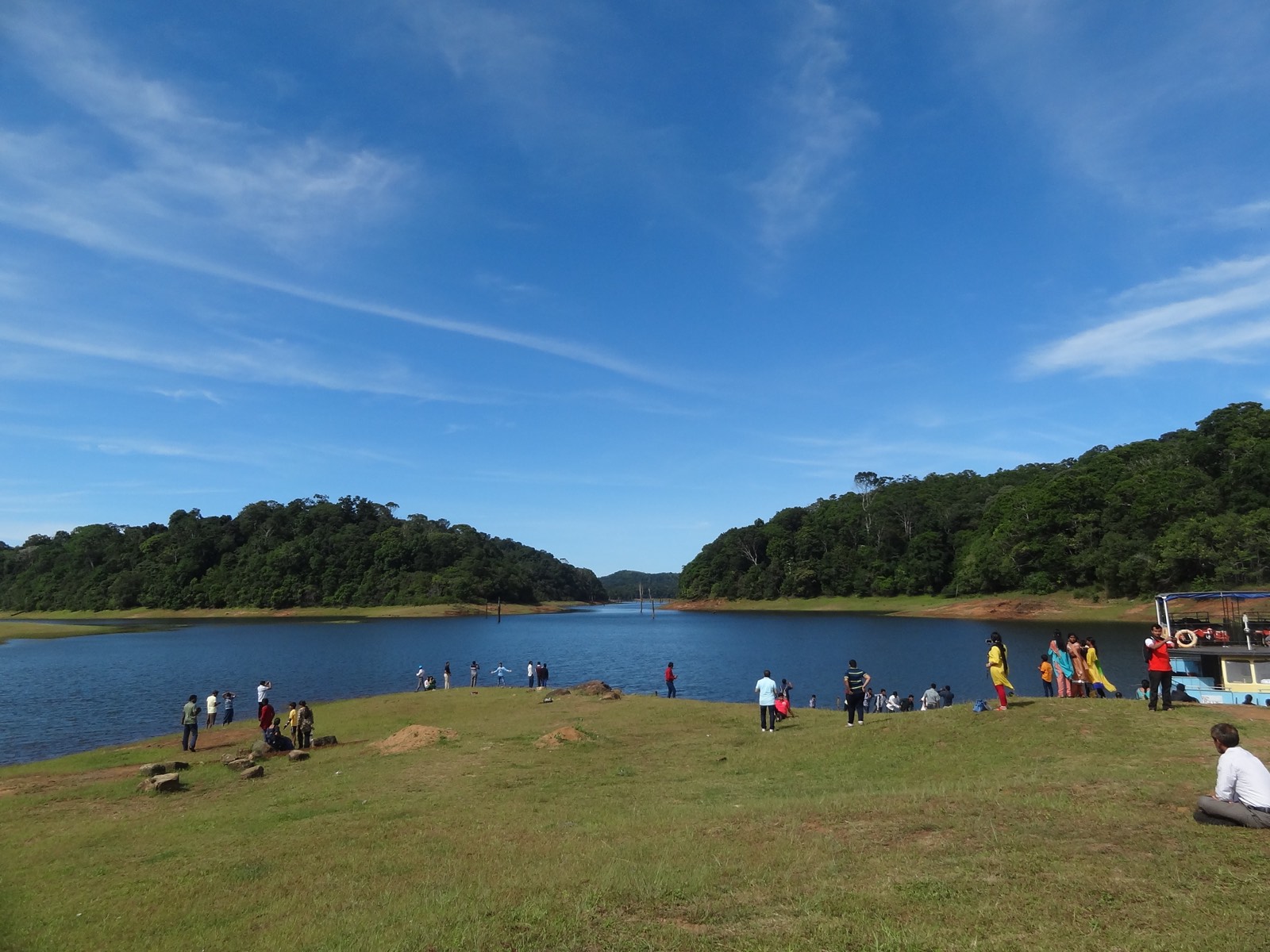
Periyar Lake, the reservoir the dam created in 1895, sits inside the Periyar Tiger Reserve (925 km², under Project Tiger since 1978), home to an estimated 30–40 tigers depending on survey year (35 in 2016, 40 in 2017, 30 in the 2022 All India count, against 31 at Kerala's other tiger reserve, Parambikulam, for comparison), and part of a landscape holding roughly 14,612 elephants, close to half of India's entire elephant population as of the 2017 census (the Periyar-specific count is older, ~1,100 in 2005; nationally, elephant counts fell from 29,964 in 2017 to 22,446 in 2025, almost certainly a methodology change, sighting/dung surveys to DNA sampling, rather than a real 25% population collapse). The characteristic skeletal dead trees rising from the water are forest that was flooded when the dam first filled; wildlife has adapted to the reservoir's shoreline as if it were a natural lake, with elephants, gaur and sambar deer gathering at the water's edge to drink and graze exposed grassland as levels fall.
Beyond the headline species, the reserve holds 266 recorded bird species, 45 reptile species, roughly 40 fish species (including three Periyar-endemic fish: trout, latia and barb, found nowhere else), around 160 butterfly taxa, and 1,965 flowering-plant taxa.
A 2015–16 ecosystem-services valuation put the reserve's total annual benefit at ₹17.6 billion, broken down roughly as: gene-pool protection ₹7.86B (the single largest line item), water delivered to Tamil Nadu ₹4.05B, wildlife habitat ₹3.55B, water purification ₹483M, recreation ₹425M, and employment ₹25M. Notably, that valuation explicitly counts the water delivered to Tamil Nadu as one of the reserve's own ecosystem services, folding the dam dispute's central resource directly into the park's official economic narrative.
Tourism economy
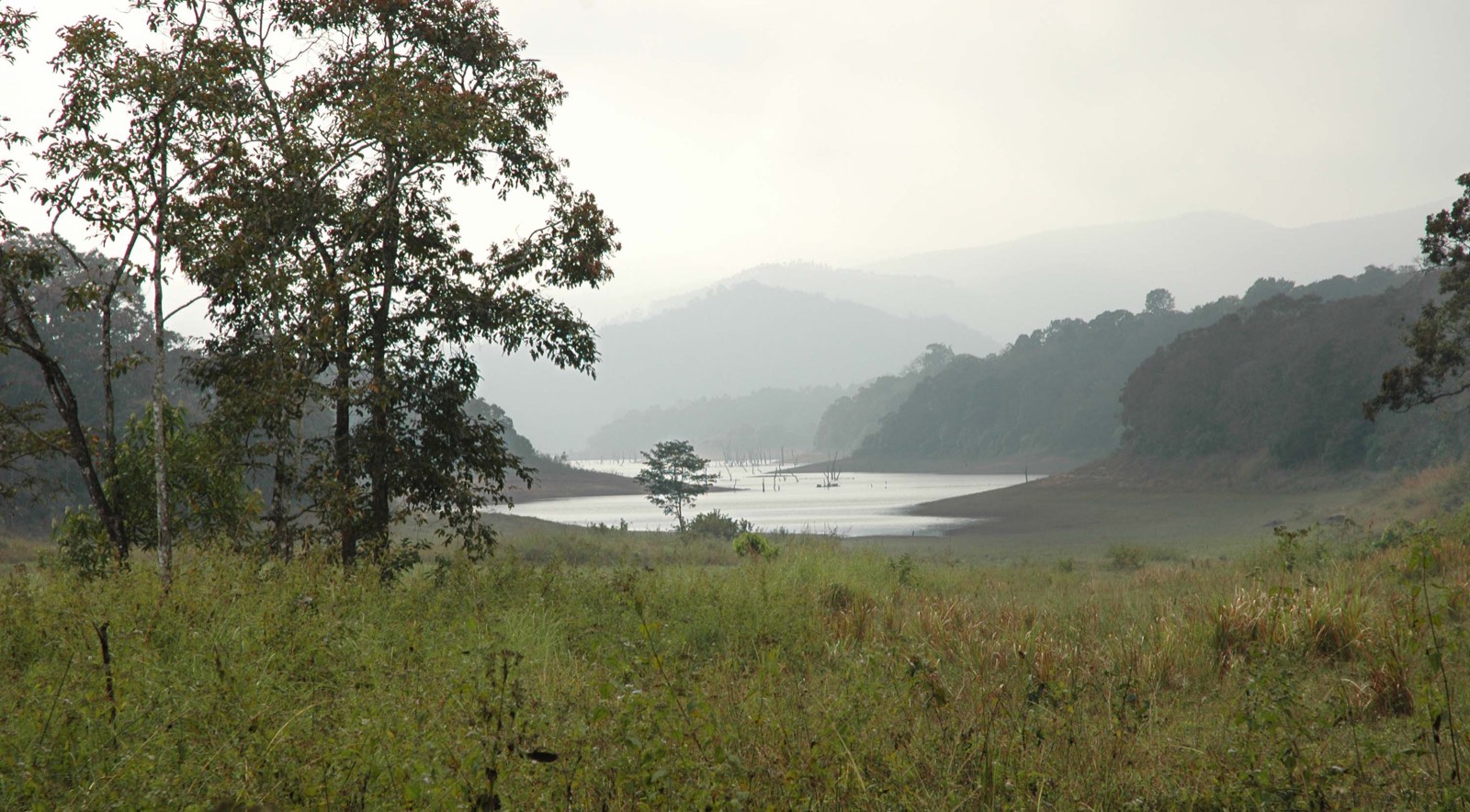
The reservoir is Kerala's only tiger reserve where wildlife can be viewed from a boat, and the KTDC boat safari built around it (five daily departures, ₹450/head) drew at least 754,306 visitors in 2016, the most recent hard figure available. Beyond the boat safari, KTDC also runs bamboo rafting on the reservoir, the one activity confirmed as "managed by the local tribal community," a rare, directly-sourced data point on tribal involvement in the tourism economy here.
A real, fatal safety crisis already happened on this water: the 2009 Thekkady boat disaster. The KTDC double-decker Jalakanyaka, commissioned only 44 days earlier, capsized on 30 September 2009, killing 45 of 82 people aboard, overloaded (87 passengers against a 75-person capacity), with no life jackets and no lifeguards, after the helmsman made a sharp high-speed turn when tourists spotted wildlife onshore. The state announced ₹500,000 compensation per victim's family, and Tourism Minister Kodiyeri Balakrishnan announced reforms within a week: mandatory life jackets for passengers under 15, mandatory safety inspections for all tourist boats, and lifeguards scaled to passenger numbers. It stayed a boat-safety story with an operational fix, and never became a dam-safety story, even though it happened on the same reservoir. Worth noting as a contrast to how quickly rumor cycles about the dam itself spread (see Safety).
Pilgrimage sites on the river
The Periyar's course passes several major religious sites. Kalady, directly on the riverbank, is venerated as the birthplace of the philosopher Adi Shankara, with a shrine complex maintained by the Sringeri Sharada Peetham he founded. Aluva, further downstream, hosts one of Kerala's largest annual Hindu gatherings, the Sivarathri festival, held not in a temple courtyard but literally on the river's sandbank. Malayattoor, on a hill "girdled partially by the Periyar," is one of Kerala's most important Christian pilgrimage sites, tied to a St. Thomas the Apostle legend.
999 hearths: the Pennycuick Pongal
In villages across Theni district, Palarpatti, Veerapandi, Balarpatti, Kutchanoor, Kuzhiyanur and Surulipatty among them, farmers hold a tradition unlike almost anything else in this story: each January, 999 hearths are lit, a deliberate echo of the lease's 999-year term, to prepare pongal in front of images of Colonel Pennycuick. Some families name children after him; many keep his portrait in their homes, offering prayers and garlands much as they would a household deity. Physical memorials include a bronze statue at Madurai's PWD office, busts at Thekkady and Uthamapalayam, a bus terminus in Theni, and, added in 2018, apparently at the instigation of Tamil Nadu admirers, a commemorative plaque at his actual grave in Frimley, England.
This veneration has been explicitly used in Tamil Nadu electoral politics: DMK leaders in both 2014 and 2019 made manifesto promises to raise the reservoir level to 152 ft, drawing on the same emotional water-bond this tradition represents.
The popular story behind the veneration, that Pennycuick personally sold his family's property to fund the dam's completion, is the same legend flagged as disputed by his own family's historians on the History page. The tradition endures regardless of whether the founding story is literally true.
What Kerala's side doesn't have
Despite active searching, this research found no comparable Kerala-side commemoration for the roughly 483 workers who died building the dam: no memorial day, no documented ceremony, even though the construction-era cemetery is a known physical site just north of the dam. This asymmetry, Tamil Nadu actively celebrating the dam's benefactor, no found evidence of parallel memorialization for the workers who built it, is worth noting as a real finding, not proof that no such tradition exists; it may simply be under-documented in English-language sources.
Film & popular culture
The dispute has produced genuine censorship history. Tamil Nadu banned the 2011 film Dam 999, a disaster film formally about China's 1975 Banqiao failure but widely read as Mullaperiyar commentary, the day before its release; the Supreme Court upheld the ban in 2013. The 2025 Malayalam film L2: Empuraan, depicting a fictional dam collapse read as a direct allegory for Mullaperiyar, triggered real political controversy: Rajya Sabha MP Vaiko demanded the scenes be cut, and it was raised in the Tamil Nadu Assembly. A 21-minute documentary, Dams: The Lethal Water Bombs (2011, same director as Dam 999), won awards at two Los Angeles film festivals for its case specifically built around Mullaperiyar failure risk.
Most of this media leans toward the "dam is dangerous" framing, which makes one counterweight worth flagging explicitly: Mullai Periyar Dam – The Real Story, a documentary built around interviews with Tamil Nadu government engineers who have worked on the dam, presenting the state's "it's safe" case directly rather than through a news soundbite. It's a much smaller production with no festival recognition, but it's the clearest counterbalancing media artifact this research found.
Tribal communities
Idukki district has Kerala's second-highest Scheduled Tribe population share. The Mannan, described as "the only existing tribal kingdom in South India," headquartered at Kozhimala near Kattappana, maintain 42 settlements across the district, including one at Kumily, immediately adjacent to the reserve. Their king is elected, not simply inherited, under a distinctive matrilineal succession system. The Muthuvan, forest-dwelling cultivators of the Anaimalai hills spanning the Kerala-Tamil Nadu border, are the district's other significant documented community, organized into settlements of 30-plus families under an elected headman, with their own migration legend explaining their name. No source found in this research directly ties either community's displacement to the dam's 1895 construction or the reserve's later establishment specifically; the documented displacement pressure in the region traces more broadly to the colonial-era tea and cardamom plantation economy.
In the media
Beyond Indian coverage, the BBC ran at least five separate articles on the dispute during the 2011–2012 flare-up. The New York Times has cited Mullaperiyar as a global cautionary example in aging-dam commentary rather than running a dedicated feature. Two dedicated books exist: Pradeep Damodaran's The Mullaperiyar Water War, and a 2025 Malayalam book by former Samara Samithi chairman C.P. Roy. No Guardian or Al Jazeera coverage, and no dedicated photography exhibition, was found, genuine gaps rather than a comprehensively documented popular footprint.
Sources
- Wikipedia: Periyar National Park; Periyar Tiger Reserve; Kalady; Aluva; Malayattoor; L2: Empuraan; Dam 999; Mannan (caste); Kozhimala; 2009 Thekkady boat disaster
- The South First: "Pennycuick, Pongal, forced agreements, politics and lives at stake"
- KTDC: official boating and activities pages
- Kerala Forest Department: Periyar Tiger Reserve notification records
- BBC News: Mullaperiyar coverage, 2011–2012
- Pradeep Damodaran: The Mullaperiyar Water War: The Dam That Divided Two States